


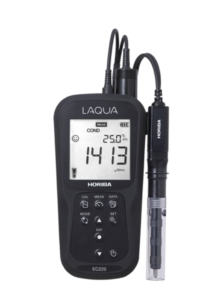
 Conductivity is one of the most widely used water quality measurements in the field. It is also one of the most commonly misunderstood. A single conductivity reading can be reported as µS/cm, mS/cm, and converted to ppm, ppt, Ω·cm, or as a salinity percentage. The relationships between these values depend on settings that most users never adjust. This guide explains what a portable conductivity meter actually measures, how TDS, salinity and resistivity are derived from conductivity, and what to check when your readings don’t match a laboratory result.
The specifications and worked examples below are based on the HORIBA LAQUA 200 Series portable conductivity meters (EC210-K, EC220-K, PC210-K and PC220-K) that Australian Scientific supplies as the authorised Australian HORIBA agent. The principles apply to any modern portable conductivity meter.
What does a portable conductivity meter measure?
A portable conductivity meter measures the ability of a water sample to carry an electrical current. This is called electrical conductivity (EC) and is expressed in microsiemens per centimetre (µS/cm) or millisiemens per centimetre (mS/cm). Conductivity is a direct physical measurement: the meter applies an AC voltage between two or more electrodes and measures the resulting current.
Total dissolved solids (TDS), salinity, and resistivity are calculated from the conductivity reading using conversion factors built into the meter. They are not independent measurements. If your TDS or salinity reading appears incorrect, it could be a setting on the meter and not a problem with the calibration.
Parameters measured by the HORIBA LAQUA EC210-K and EC220-K
| Parameter | Units | Range | How it’s derived |
|---|---|---|---|
| Conductivity (EC) | µS/cm, mS/cm | …µS/cm to 200.0 mS/cm (k=1.0) | Direct measurement |
| TDS | ppm, ppt | …ppm to 100 ppt | Calculated from EC using a TDS factor (programmable) |
| Salinity | ppt, % | 0.0 to 100.0 ppt / 0.00 to 10.00% | Calculated from EC via NaCl or Seawater curve |
| Resistivity | Ω·cm, MΩ·cm | 0.000 Ω·cm to 20.0 MΩ·cm | Inverse of conductivity (1/EC) |
| Temperature | °C, °F | -30.0 to 130.0 °C | Direct measurement (integrated sensor) |
Conductivity vs TDS: why the same sample gives different ppm readings
TDS is not measured directly by a portable conductivity meter. The meter measures conductivity and multiplies it by a TDS conversion factor to produce a ppm reading. The HORIBA LAQUA EC210-K and EC220-K offer four TDS calibration curves, and the curve you select changes the ppm value for the same physical sample.
TDS conversion curves on the LAQUA EC210-K and EC220-K
| Curve | Typical application | Notes |
|---|---|---|
| Linear (0.40 to 1.00) | General use, user-defined factor | Default factor 0.5; adjust to match your calibration solution or laboratory correlation |
| EN27888 | European drinking water and wastewater reporting | Non-linear curve aligned with ISO 7888:1985 |
| 442 | Natural waters with mixed mineral content | Based on 40% sodium sulphate, 40% sodium bicarbonate, 20% sodium chloride |
| NaCl | Brines, saline bore water, sodium-dominated solutions | Non-linear curve for solutions dominated by sodium chloride |
Two meters measuring the same glass of water can report different TDS values if they use different conversion factors. If you are comparing results with a laboratory, or reporting against a specification, agree on the scale before you start. Either report conductivity directly, or specify the TDS curve and reference temperature being used.
 How to calibrate a portable conductivity meter
Calibration is performed in conductivity mode only. Because TDS and salinity are calculated from the conductivity reading, calibrating conductivity automatically re-references both. The HORIBA LAQUA EC210-K and EC220-K support automatic calibration at up to four points and manual calibration at up to five points.
Standard calibration procedure
- Rinse the electrode in deionised water and blot dry with lint-free tissue. Do not wipe the sensing surface.
- Pour fresh standard into a clean container to a depth of at least 3 cm. Never calibrate directly from the bottle, and never reuse standard solution.
- Immerse the electrode at a slight angle to dislodge air bubbles from the sensing cavity. Bubbles are the single most common cause of unstable conductivity readings.
- Wait for temperature to stabilise. Conductivity changes roughly 2% per °C. The meter’s automatic temperature compensation (ATC) handles this, but the probe and sample still need to be at the same temperature.
- Calibrate low to high. Always start with the lowest standard (84 µS/cm) and work up to higher values (1413 µS/cm, 12.88 mS/cm, 111.8 mS/cm). This minimises carry-over contamination.
- Rinse between standards in deionised water, not in the next standard. Rinsing in the next standard contaminates the bottle.
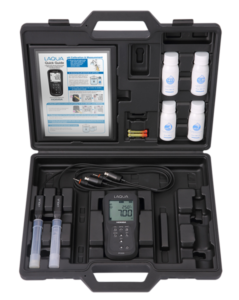
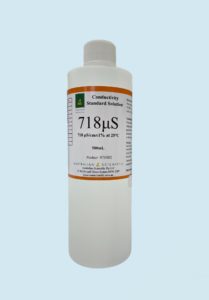
The HORIBA LAQUA 200 Series kits include all four standards (84 µS/cm, 1413 µS/cm, 12.88 mS/cm, and 111.8 mS/cm), covering ultra-pure water through to high-salinity samples. Replacement standards are available separately through our calibration solutions range.
How often should you calibrate a conductivity meter?
For general field work, calibrate at the start of each measurement session. For regulatory or GLP reporting, calibrate before each batch of readings and verify with a check standard at the end. Conductivity electrodes drift more slowly than pH electrodes, but drift still accumulates, particularly if the electrode is used in samples with high organic content or stored dry.
Salinity: NaCl versus Seawater curves
Salinity is calculated from conductivity using one of two curves on the LAQUA EC210-K and EC220-K:
- NaCl curve. For freshwater, brackish, industrial and agricultural samples where the ionic composition is dominated by sodium chloride. Reported in ppt or %.
- Seawater curve. For marine, estuarine and aquaculture applications. Follows the relationship used in oceanographic practice for natural seawater.
Using the wrong curve produces systematic errors. A marine aquaculture sample measured on the NaCl curve will read low compared to the true practical salinity, because natural seawater contains additional ions (magnesium, sulphate, potassium) that contribute to conductivity but are not accounted for in the pure-NaCl conversion.
Resistivity: when you need the inverse of conductivity
Resistivity is conductivity expressed the other way round. It is used almost exclusively for ultra-pure water, where the conductivity value becomes inconveniently small. Theoretically pure water has a resistivity of 18.2 MΩ·cm at 25 °C; most pharmaceutical water systems target 1 MΩ·cm or higher. The HORIBA LAQUA EC210-K and EC220-K measure resistivity up to 20.0 MΩ·cm with the supplied k=1.0 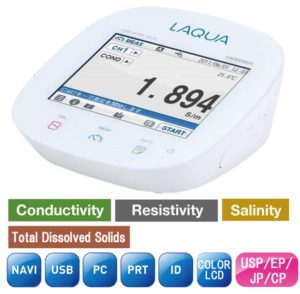 electrode.
Resistivity is the right mode for:
- Semiconductor manufacturing and electronics cleaning
- Pharmaceutical water systems (Purified Water, Water for Injection)
- Power generation boiler feedwater
- Laboratory deionised water systems
For drinking water, environmental monitoring, aquaculture and most industrial process water, conductivity (µS/cm or mS/cm) is the more practical unit.
Temperature compensation: why your readings move when they shouldn’t
Conductivity increases with temperature by roughly 1.8–2.2% per °C, depending on the solution. Every modern conductivity meter corrects for this by compensating the measured value back to a reference temperature (usually 25 °C). On the LAQUA EC210-K and EC220-K, both the reference temperature (15–30 °C, adjustable) and the temperature coefficient (0.00–10.00%/°C, adjustable) are user-configurable.
Automatic Temperature Compensation (ATC) is active by default. If your readings shift noticeably as the sample warms or cools in the container, check three things:
- That ATC is enabled and the temperature sensor in the probe is reading correctly.
- That the temperature coefficient matches your sample type (the default 2.00%/°C is appropriate for most natural waters; highly acidic or basic solutions behave differently).
- That you are comparing readings at the same reference temperature. A reading compensated to 25 °C is not directly comparable to one compensated to 20 °C.
Common causes of unstable or inaccurate readings
If your portable conductivity meter is drifting, or giving suspicious readings, the cause is almost always one of the following:
- Air bubbles on the sensing surface. Immerse the probe at an angle and gently tap the side of the container to dislodge bubbles. The cavity in a cell-constant probe traps bubbles readily.
- Residue on the electrode. Nutrient salts, biological films, oil, and mineral scale all coat the sensing surface and suppress the reading. Clean with dilute nitric acid or a mild detergent rinse, then recalibrate.
- Wrong cell constant selected. The 9383-10D electrode supplied with the LAQUA 200 Series is k=1.0. The meter allows selection of 0.1, 1.0, or 10.0 cell constants for use with different electrodes. A mismatch produces readings off by an order of magnitude.
- Stale or contaminated calibration standard. Conductivity standards absorb CO₂ from the air and drift over time, particularly low-value standards (84 µS/cm). Decant fresh standard for each calibration.
- Temperature not stabilised. A probe straight out of a cold case takes several minutes to equilibrate with a warm sample.
- Comparing ppm readings across different TDS factors. Two meters reading the same sample can give different ppm values if the TDS conversion curve or factor differs. Compare conductivity (µS/cm) instead.
Applications where portable conductivity meters are the right tool
Portable conductivity meters like the HORIBA LAQUA EC210-K and EC220-K are used across a broad range of Australian industries:
- Environmental monitoring. River, lake, groundwater and estuary assessments, where conductivity acts as a broad indicator of water quality and a screening parameter for pollution events.
- Drinking water. Rapid verification of TDS at treatment plants and distribution points, supplementing fixed online analysers.
- Wastewater and industrial discharge. Conductivity monitoring against licence conditions, plus process control on evaporation, reverse osmosis and ion-exchange systems.
- Aquaculture and hatcheries. Salinity measurement using the Seawater or NaCl curve, for marine, estuarine and freshwater species.
- Agriculture and horticulture. Soil leachate, irrigation water and fertigation nutrient monitoring, reported as EC rather than TDS where possible.
- Laboratory and pharmaceutical. Verification of purified water, deionised water, and reagent-grade water using resistivity mode.
 When to choose a combined conductivity and pH meter
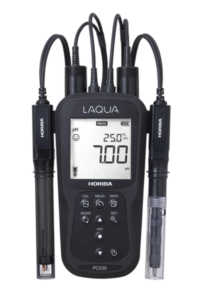
If you routinely measure pH alongside conductivity, a combined instrument removes the need to carry two meters. Australian Scientific stocks two dual-channel models:
- LAQUA PC210-K. Combines the EC210-K conductivity module with a pH/ORP channel. Includes the 9652-10D gel-filled pH/temperature electrode.
- LAQUA PC220-K. Combines the EC220-K (with GLP data logging) with pH/ORP. Recommended where data export and audit trails are required.
For field surveys that need additional parameters (turbidity, dissolved oxygen, depth, GPS), the HORIBA U-50 Series multiparameter meters measure up to 11 parameters from a single sonde and are better suited to profiling work in rivers, lakes and bores.
Frequently asked questions
What is a good conductivity reading for drinking water?
Australian Drinking Water Guidelines do not set a numerical conductivity limit, but most treated municipal drinking water in Australia reads between 100 and 800 µS/cm. Values above approximately 1500 µS/cm generally indicate elevated mineral content and may affect taste. Conductivity is used as a rapid indicator, and any significant change from a supply’s baseline warrants investigation.
Can I use a conductivity meter to measure salt in water?
Yes, using the salinity mode. For freshwater and industrial samples, use the NaCl curve. For marine and estuarine samples, use the Seawater curve. The LAQUA EC210-K and EC220-K measure salinity from 0.0 to 100.0 ppt (0.00 to 10.00%).
What’s the difference between a conductivity meter and a TDS meter?
They are the same instrument. A TDS meter is a conductivity meter with a fixed internal conversion factor and a display that shows ppm instead of µS/cm. Professional conductivity meters like the LAQUA EC210-K let you choose the TDS conversion curve and factor, and also display conductivity, salinity and resistivity directly.
Does a conductivity meter need to be calibrated every time?
Your meter may not need to be calibrated all of the time, but it should regularly be checked against calibration standards. If it reads accurately, calibration is not required. For routine field work, calibrate at the start of each measurement session. For GLP or regulatory reporting, calibrate before each batch and verify at the end with a check standard. Conductivity electrodes are more stable than pH electrodes and do not require the same frequency of calibration, but verification is always worthwhile.
What is IP67 and why does it matter for a portable conductivity meter?
IP67 is an international ingress protection rating indicating the instrument is fully dust-tight and protected against temporary immersion in water (up to 1 metre for 30 minutes). It is the appropriate rating for field use around open water, treatment plants and industrial environments. Both the LAQUA EC210-K and EC220-K are IP67 rated. Time, wear and tear can impact this.
 What accessories do I need with a new portable conductivity meter?
The HORIBA LAQUA EC210-K and EC220-K kits are supplied complete with the 9383-10D Ti/Pt conductivity electrode, four calibration standards (84 µS/cm, 1413 µS/cm, 12.88 mS/cm, 111.8 mS/cm), batteries and carrying case. Consumables to budget for separately are replacement calibration standards and, eventually, a replacement conductivity electrode. For GLP work on the EC220-K you will also need the USB cable (PN 3200779639) or the RS232 printer cable (PN 3200779638).
Should I choose the EC210-K or EC220-K?
Choose the EC210-K for routine field work where readings are recorded by hand or where on-meter storage of up to 500 data points is sufficient. Choose the EC220-K where you need GLP-compliant date/time stamping, 1,000-point logging, and PC export via USB. The EC220-K is typical for regulatory reporting, contract environmental monitoring, and any workflow that must produce an audit trail. Both meters share the same measurement hardware, electrode and accuracy specifications.
View the portable conductivity meter range
The full portable conductivity meter range, including the EC210-K, EC220-K, PC210-K and PC220-K, is available from Australian Scientific with Australian stock, 3-year meter warranty (6 months for the electrodes), and authorised HORIBA technical support. If you’re unsure which model suits your application, contact our team for advice.