Results for {phrase} ({results_count} of {results_count_total})
Displaying {results_count} results of {results_count_total}



Australian Scientific stocks 172 laboratory balances and weighing scales from A&D Weighing and OHAUS, covering everything from a $150 portable compact balance to a $17,955 semi-micro premium balance. The range spans four classes: analytical and precision balances, compact and portable balances, industrial and platform scales, and moisture analysers.
Choosing a balance comes down to two numbers: the heaviest thing you need to weigh (capacity), and the smallest difference you need to see (readability). Everything below is organised around those two, so you can narrow down before you start comparing models.
A representative spread of current stock. Prices are ex GST and were correct at the time of publishing.
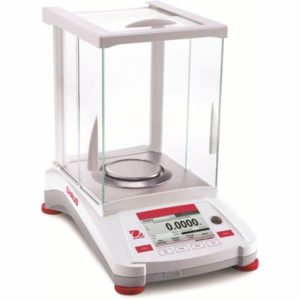
The largest part of the range at 86 models, reading from 0.001 g down to 0.001 mg. Use these for research, pharmacy, formulation and quality control where tolerances are tight. Entry point is the A&D FX-323 at 320 g × 0.001 g; the top of the range is the A&D BA-6TE semi-micro at 6.2 g × 0.001 mg. From $1,089. Browse analytical balances.
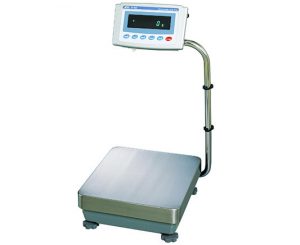
15 models from 30 kg × 2 g to 150 kg, built for warehouse, production and dispatch use. Bench, platform and parcel formats, with trade-approved versions available where goods are sold by weight. From $395. Browse industrial scales.
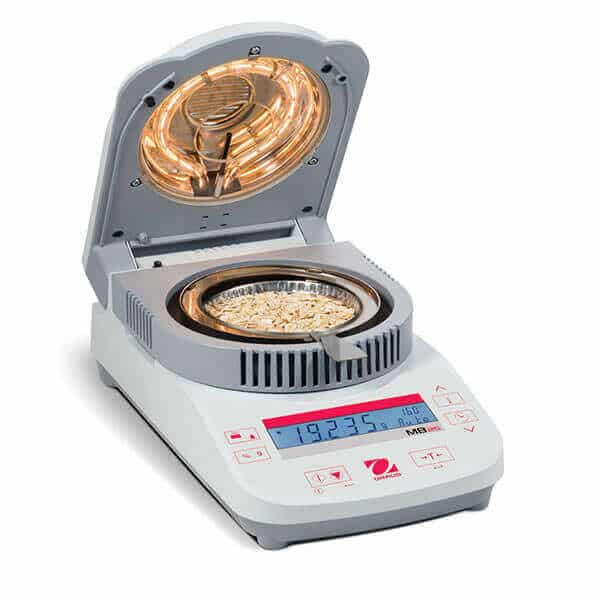
10 models using halogen or infrared heating to determine moisture content in minutes rather than hours, from 51 g × 0.005 g to 71 g × 0.0001 g. Considerably faster and cleaner than oven drying, and standard practice in food, pharmaceutical and materials testing. From $2,343. Browse moisture analysers.
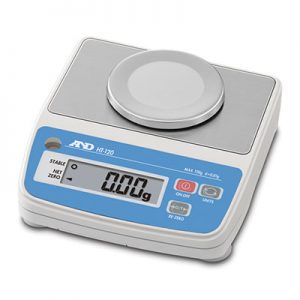
54 models from 220 g × 0.1 g up to 12 kg × 1 g, including intrinsically safe versions for hazardous areas. Less sensitive to draughts and vibration than analytical balances, so they do not need a controlled environment. That makes them practical for fieldwork, teaching, dispatch and light production. From $150. Browse compact balances.
Analytical balances: up to 150 g · 150 g–500 g · 500 g–1 kg · 1–5 kg · 5–10 kg · 10–30 kg
Compact balances: up to 300 g · 300 g–1 kg · 1–5 kg · 5 kg and above
Industrial scales: up to 30 kg · 30–60 kg · 60–100 kg · 100 kg and above
Both brands cover the full weighing range and both are supported locally. A&D Weighing is a weighing specialist, and its range here runs from semi-micro analytical balances through to washdown-rated IP65 and IP67 models and trade-approved platform scales. OHAUS spans the Explorer, Pioneer, Adventurer and Compass balance families, and also supplies centrifuges, stirrers and other laboratory equipment if you are fitting out more than the weighing bench.
Readability. An analytical balance reads to 0.1 mg or finer and usually has a draught shield, because at that resolution air movement affects the reading. A precision balance reads to 0.001 g or coarser and does not need one. Analytical balances are for formulation, assay and research; precision balances suit general laboratory and production weighing at larger capacities.
Work from your smallest weighed quantity and the accuracy your method requires, not from the balance capacity. As a rule the readability should be at least ten times finer than the smallest difference that matters to your result. Weighing 50 mg samples to 1% means you need to resolve 0.5 mg, so a 0.1 mg analytical balance is appropriate and a 0.01 g precision balance is not.
Internal calibration should be run daily or before each session, and most analytical models here have automatic internal calibration that handles it. Formal external verification is typically annual, and is what your quality system or auditor will ask to see. Balances used for trade have their own legal requirement, covered below.
If you sell goods by weight, yes. It is a legal requirement in Australia, not a preference. Trade-approved models are supplied with pattern approval and are usually offered at coarser readability than their non-trade equivalent. Both versions are stocked for several models, so check the listing carefully. See trade approved balances and verification class for what applies to your situation.
When moisture content is the measurement, rather than mass. A moisture analyser weighs the sample, heats it, and reports the percentage lost. It does so in minutes, against hours for oven drying, and without a separate desiccator step. It is a different instrument to a balance and is not interchangeable with one.
For most applications either will do the job and the decision comes down to the specific model, price and what you already run. A&D has the stronger industrial and washdown range; OHAUS has a broader laboratory equipment range beyond weighing. Full ranges are on the A&D Weighing and OHAUS pages, or contact us for a recommendation against your application.